The Kirkpatrick Model is one of the most well-known training evaluation frameworks—yet many Malaysian SMEs avoid it, assuming it is too academic or designed only for large corporations.
In reality, the model works well for SMEs when applied selectively and practically, not as a full four-level checklist.
What the Kirkpatrick Model really measures?
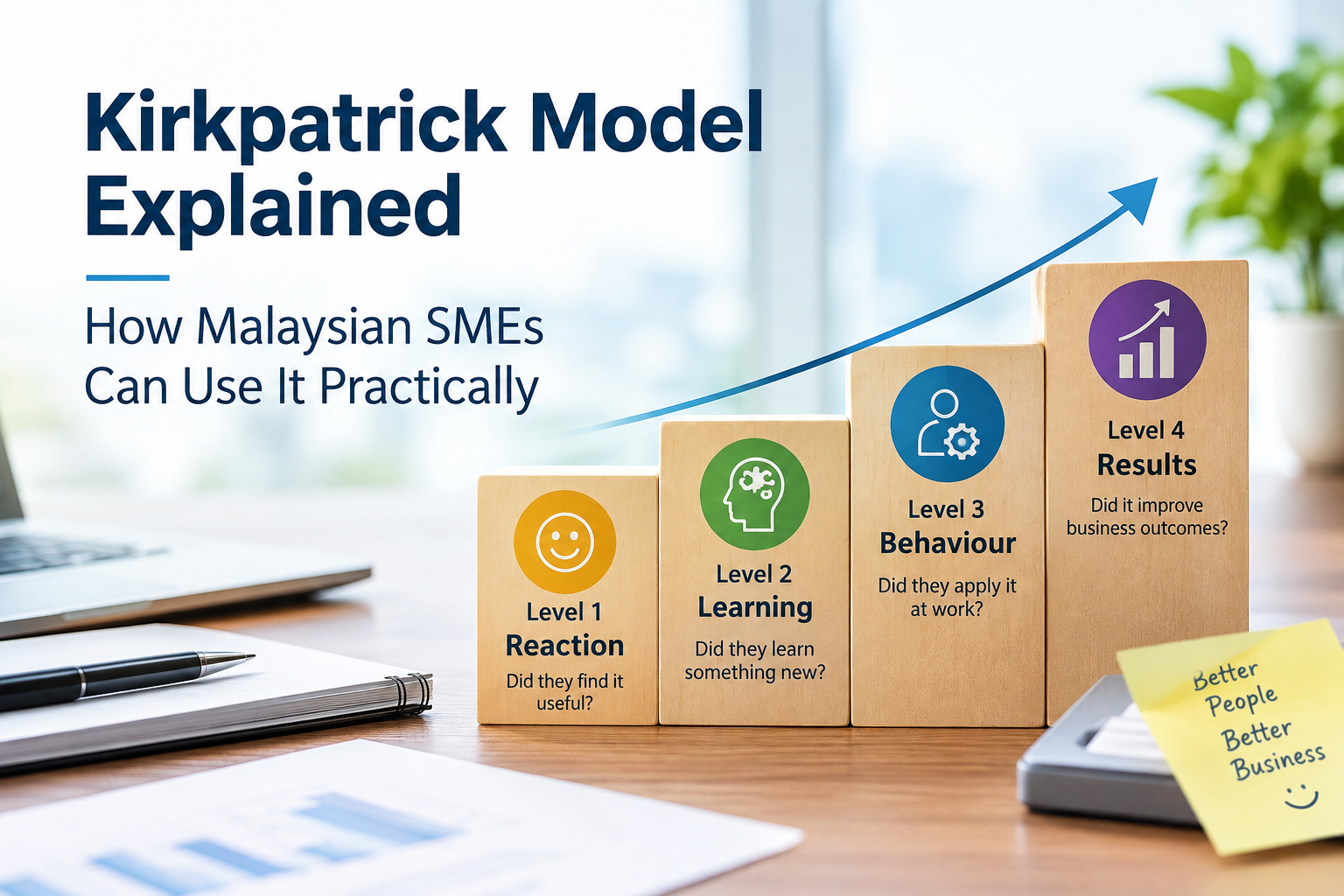
The model looks at four questions:
- Did participants find the training useful?
- Did they learn something new?
- Did their behaviour change at work?
- Did this change improve business results?
For SMEs, the real value lies in Levels 3 and 4—behaviour and results.
Levels 1 and 2 are hygiene checks, not the goal.
Why SMEs struggle with the model?
Common SME challenges in Malaysia include:
- limited HR resources
- overloaded managers
- fear of complex reporting
- lack of clean data
As a result, training impact is either over-surveyed or not measured at all.
The solution is simplification, not abandonment.
How SMEs should apply Kirkpatrick (the practical way)?
Level 1: Reaction — Keep it short
Ask only three questions:
- Was this training relevant to your job?
- Will you apply something within 30 days?
- What may stop you from applying it?
This reveals application risk immediately.
Level 2: Learning — Don’t over-test
One scenario question or short role-play is enough.
If participants can’t explain how they would act differently, learning hasn’t happened.
Level 3: Behaviour — where SMEs should focus
Track visible, repeatable behaviours only.
Example (manager soft skills):
- giving feedback early
- assigning clear ownership
- resolving issues without escalation
Use a simple Yes/No checklist weekly or bi-weekly.
No dashboards required.
Level 4: Results — directional, not financial
SMEs don’t need complex ROI formulas.
Look for movement in:
- escalation volume
- repeat customer complaints
- decision turnaround time
- rework or recurring issues
Even one or two indicators are enough.
A real SME-style example
A 120-employee Malaysian SME trained supervisors on accountability.
Within two months:
- issues were resolved earlier
- escalations to the GM reduced
- task ownership became clearer
No complex data. Clear business improvement.
What SMEs should avoid?
- Measuring all four levels in detail
- Chasing exact financial ROI
- Running surveys without action
- Turning measurement into bureaucracy
This is why the model often fails.
Where HRD Corp–claimable training fits?
For Malaysian SMEs, this simplified Kirkpatrick approach:
- supports HRD Corp documentation needs
- strengthens internal justification for training spend
- keeps evaluation manageable
Final thought
For SMEs, the Kirkpatrick Model is not a reporting tool. It is a thinking framework to keep training honest. Measure behaviour first. Results will follow.